
Academic Freedom Was Born Out of a Stanford Scandal
Today, university speech makes headlines. But the concept of academic freedom is surprisingly new. Its origins trace back to 19th-century Germany—and its American form began right here at Stanford in 1900.
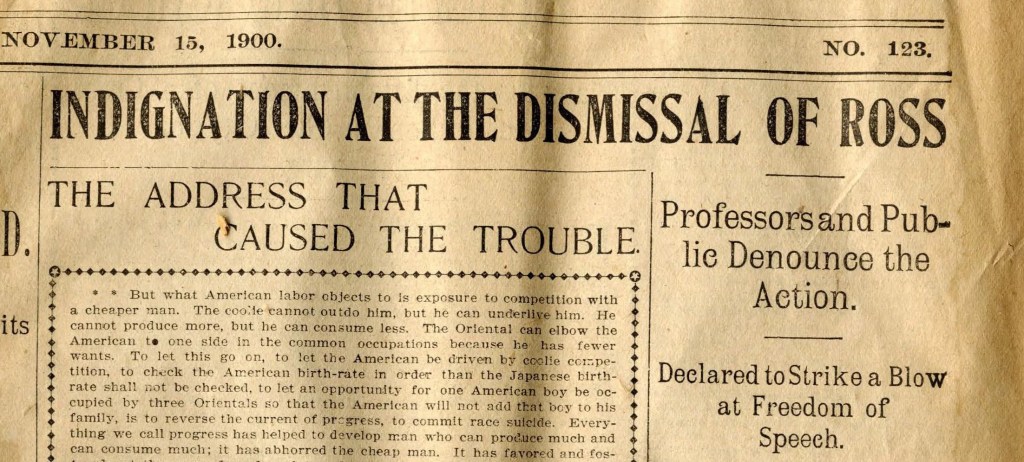
That year, Stanford’s founding president, David Starr Jordan, forced the resignation of Edward A. Ross, a prominent and popular professor. Ross was not fired for being a eugenicist and a racist. His real offense was advocating populist political views that clashed with those of the university’s benefactors.
In response, fellow professor Arthur Lovejoy resigned in protest. Five years later, Lovejoy co-founded the American Association of University Professors (AAUP) and helped draft its 1915 Declaration of Principles on Academic Freedom and Academic Tenure – the first major U.S. document to defend academic freedom.
Below you can hear Professor Emily J. Levine revisit the Stanford scandal that launched the idea of academic freedom in America.in her talk “How a Stanford Speech Scandal Led to the Invention of Academic Freedom: The Case of Edward A. Ross.”
You can learn more about the founding and history of the AAUP here.
 AAUP Stanford Chapter